
What We Own
- Author(s):
- Amy Cooke
- Issue:
- Fire (July 2026)
- Department:
- Inward Light
It was the wind that woke us that night. We had been sleeping under mosquito netting draped over our outside bed in the late summer garden, clouds scudding in from the west. The air swirled around us, cooler than inside our tin-roofed house, fragrant with herbs and flowers breathing in earthen beds.
Rain followed the wind, touching our faces with gentle drops. We rose, removed the mosquito netting, and covered the bed with a tarp. With the cats, we scampered inside as raindrops made dark circles in the dry earth.
We settled, rain pinging on the roof, windows open to the charged air, when a flash of brilliant white cracked outside, accompanied by a boom that shook the house. We walked onto the deck, looking into the darkness, sniffing the air for smoke, our eyes scanning for fire. Nothing. The storm rumbled away into the east, flashes of lightning occasionally illuminating the landscape. We returned to bed and uneasy sleep.
Chamba nudged me a few hours later. “I smell smoke.” A glance at our phones showed no internet and no cell service. No information beyond what our senses were telling us. We began the dance we had rehearsed. Curtains off the windows, each window cranked shut, sealing out sparks. All lights on, so the house could be seen through the smoke, already filling the air, making the gray dawn ghostly. Ash drifted through the stillness. I felt calm, focused, light. We checked the list, divided up tasks.
An hour later, the high-low siren echoed up to our ridge from Jones Bar Road. The sound lurched in my chest. We had to go. We coaxed the cats into their carriers, grabbed a few things, and got in the car. Down the dirt road, toward the fire—no other way out. The yellow-clad firefighters were clustered at Nishinam Gulch Road. They waved us by. A fire plane arced into the canyon, releasing a plume of water.
As soon as we had cell service, we called our neighbors, Doug and Dorothy, who shared our ridge of pine and manzanita. We met in town at the Safeway parking lot, 8 miles from the dark plume rising into the blue morning, where other cars gathered. We checked the internet, grateful for YubaNet and the CalFire sites. The fire had a name. The Jones Fire. 10 acres, 60 personnel. Air support. Deep canyon. Heavy brush. We shared memories of last year’s fire, also nearby, contained quickly.
The sun rose, an orange orb in the smoky sky, and bathed us with a cataclysmic light, bringing the first sense of the day’s heat. We called friends a few blocks away—could we bring the cats over? I had a massage scheduled—should I go? We parted ways from our neighbors, promising to stay in touch throughout the day.
Jenny and Marc met us at their door. With the cats settled in their guest room, we tried to calm our worries. I went to my massage and, amazingly, almost fell asleep on the table, the tension I’d been holding easing away under loving hands. I emerged an hour later to ash sifting down in gray flakes covering the cars and porch. This fire was part of a larger “gigafire” in California, the CZU Lightning Complex. Altogether, the lightning strikes on August 16, 2020, would burn over 1 million acres across seven counties, an area larger than Rhode Island.
A wind gust buffeted our friends’ house, an ominous sound. I imagined our house alone, crouched like an animal we had left behind. I wanted to go back, rescue it, my chest tight with fear. I imagined it as we left it this morning, dishes in their cupboards and my grandmother’s silverware in the drawer. At 9 p.m., the CalFire Division chief gave a briefing. 340 acres. 0% contained. Limited resources, fires throughout the state. Perimeters. Containment. Evacuation orders. The words blurred together.
By the next morning, the map had changed; the red area marking the growing fire had filled in the borders marked by Jones Bar Road and Newtown Road. Borders containing our home, our walks, our road, our garden. The fire’s boundaries were our boundaries.
We began the long drive to Southern California to be with our daughter. On the way, a friend called us. Her son worked for the local television station. Would we talk to them? We pulled over at the next exit, and I sat on a bench in the dry heat to take the call. The reporter had been let into the burned area. I’m sorry to tell you, your house did not make it. Your house is gone.
I staggered back to the car, tapping on the driver’s window. Chamba looked at my face, and then we clung to each other in the parking lot, holding on, holding. Gone. Gone. It’s gone. We called our daughter. We drove. The tears started, stopped, started again.
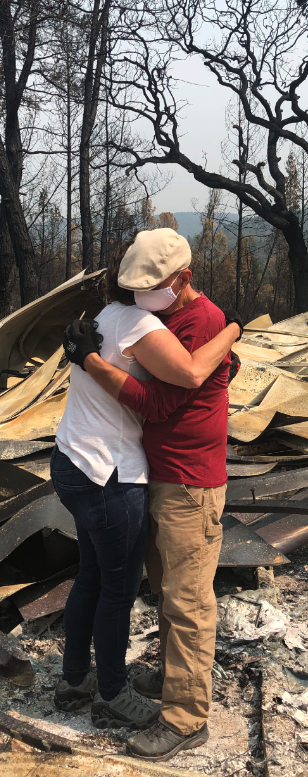
We returned two weeks later to sift through the ashes and charred remains of the few things not fully incinerated. Pottery shards re-fired into new glazes, and the occasional miracle of a whole plate. What was, was so thoroughly gone as to be unrecognizable. Occasionally, a blackened piece would make itself known, and we would gasp at the loss, spinning with the transformation of one thing to another.
Friends from Grass Valley Friends Meeting and neighbors whose homes had survived came to help as we pulled twisted objects from the gray ash. Their kindness stunned us, opened us to grief and love, allowed us to begin to see all that had been and to glimpse something deeper, waiting. We remembered that there are seeds in the soil that wait for fire—pyrophytic seeds. The heat melts their hard, resinous coat so that they wake in the ash to send their roots down to seek water and arch their green stems up to seek light. They need fire to live.
The Nisenan who lived on this land also knew fire. Their hands lit fires in rhythm for thousands of years, cleansing the old and waking the new. The colonizers’ arrogance violently extinguished their culture in the mid-1800s, as well as the fires that once fed the earth. They built homes with gold pulled from the land after the Nisenan were murdered or forced into servitude, their children sent to boarding schools. They built towns, factories, strip malls, and subdivisions, believing in permanence—that roads and houses would outlast the wisdom rooted in earth, trees, and water.
It was when we walked away that we were given the fire’s final gifts. We glimpsed the wisdom that had guided lives here for countless seasons—that we need fire. That dying is our reality, and opens us into birth. That we breathe every breath as a death of the last, and are rebirthed with the next. That what remains is love.
The fire cracked us open, melting away what we thought we needed in order to germinate new life. A life we cannot own, but can only live, until it, too, falls away into midnight lightning and fire.
Amy Cooke is a member of Grass Valley Friends Meeting in Nevada City, CA (PYM), currently residing in France, where she and her husband Chamba served as Friends in Residence at the Maison Quaker from 2021 to 2025.