
Young Friends as a Microcosm
- Author(s):
- Pan Tangible
- Issue:
- Experiences of Youth (May 2026)
- Department:
- Inward Light
Quakers didn’t make much sense to me as a child: pleasant, overly solicitous adults in a square room, being boring together on folding chairs. But then my divorcing mother took us kids to Pendle Hill for a year in 1969, and my head exploded. I was fourteen years old and discovering that Quakers were revolutionary, vital, leading-edge, mystical, and deep. Being true to our values and following an Inner Light could heal relationships and move mountains.
Quakers saw being arrested for civil disobedience as a badge of honor. Consciousness-raising groups were envisioning a future where women could be full people. I learned to hug and eat brown rice. It turned out Quakers weren’t boring at all; it’s just that the good stuff was mostly happening subtly and on the inside. Friends carried a conviction that the act of forgiveness and a quiet inner knowing could lead to peace.
I had not yet discovered Young Friends. The adults around me were an inspiration and served as lighthouses, providing not just individual examples of living with integrity, but collectively creating an environment that gave me a sense of spiritual safety. Some of that idealism would later be tested by the foibles of imperfect humans, but at least I knew and respected the ground rules.
Before we left the East Coast, my mother took us to an annual session in Asbury Park, New Jersey. The only memorable event was taking LSD for the first time with two Quaker boys and tripping all day in a dorm room. One of those young men would soon attend John Woolman School in Grass Valley. His visit over winter break to the commune we had settled in made me want to attend John Woolman, too. I quickly signed up for the spring semester. I know many former “Woolmanites” who had epically satisfying times that were life-changing and gave them friends for life. That was not my experience.
At Woolman, I was one of only half a dozen students from Quaker families, and that percentage was not enough to “hold the center.” Without shared values, trust had nothing to stand on. Most of the students were misfits sent off to a country boarding school by parents who didn’t want to deal with them anymore. Hooking up and exploitative sex were so rampant that the staff ended up piling us all onto a flatbed truck and driving us to the local Planned Parenthood to be tested and treated for STDs. While students were being busted for sneaking into each other’s rooms at night, the principal and the science teacher were busy wife-swapping, and one student was having an affair with a staff member.
We ended up getting the principal fired by signing a petition and sending it to the board of directors. It was a hugely satisfying event because it proved that what I believed about Friends was not just a platitude: Friends treat all people equally and our values are revealed in the ways we relate to each other; any Friend, young or old, is entitled to be heard and can appeal to Ministry and Oversight if they feel they are being ill-treated.
At Pacific Yearly Meeting Annual Sessions, there was a real sense of community felt among the Young Friends. Because Quakers are such a niche religion, most of us felt misunderstood and isolated in the “real world.” What a relief to live in a supportive environment, if only for a week, with other gentle souls and misfits. The lack of supervision meant that drug use and carnal activities filled our days, along with capture the flag. Young people are already inclined to peer-bond at this age, and the atmosphere of emotional safety I had first experienced at Pendle Hill reappeared. Our YF Worship Sharing groups were the first time most of us had deeply listened and shared our growing pains. Just the absence of competition and malice, so normalized the other 51 weeks of the year, felt like the lifting of an oppressive cloud. Our hearts opened to each other. We embraced the identity of Young Friend like a life raft.
But then the adults ruined everything. Pacific YM, which at the time spanned from Bellingham to San Diego and from Hawaii to Montana, was declared “too big” and “too far to travel.” They weren’t wrong. The decision was made to split into two Annual Session bodies, but this threatened to tear our newfound social safety net apart. We would now be North Pacific Yearly Meeting and Pacific Yearly Meeting. Some of us YF—those who had the time, the money, and the parental support—vowed to attend BOTH in an effort not to lose those connections. But at some point, a new container was born. It was called the Western Young Friends New Year’s Gathering. At age 20 or 21, I was among the oldest attenders; most of us were teenagers. We would meet in a heavily forested, damp, and mossy location in Myrtle Creek, Oregon, during the New Year’s holiday.
It was a grand experiment. Could a group of teenagers who all live at a distance from each other actually pull off a Quaker gathering all by themselves—including gathering the money and food and organizing the schedule? I am proud to say we did. There was the unfortunate time that, due to a lack of volunteers, the Nominating Committee settled on a 13-year-old boy’s good intentions. He showed up the afternoon of the first day with dried beans for dinner, not realizing beans need time to soak and boil before they are edible. Some of the parents were understandably concerned and sent spies (chaperones) to keep an eye on things. This felt insulting because we had been functioning quite well for years before this. But so long as they stayed in the background and didn’t try to “guide” us, it was okay. Then there was the time that the tofu that was ordered was tainted and part of a recall. After we returned to our homes, each of us was met by a public health nurse who injected something into our buttocks to stave off hepatitis.
The New Year’s Eve Meeting for Worship became a treasured ritual that I dearly missed after I finally and reluctantly admitted that there was no universe in which I could pretend to still be a “Young” Friend. We would gather on sofas and chairs around a crackling stone fireplace at Camp Myrtlewood and begin by singing. At 11:00 p.m., we would fall into silence until words started to flow. We then learned who had endured tragedy that year, who was scared of the future, and who was struggling with a big decision. There would be group hugs and weeping. Someone might break into a gospel song of encouragement, or a pagan or feminist song celebrating nature’s cycles. I always emerged feeling like I had been part of something truly sacred.
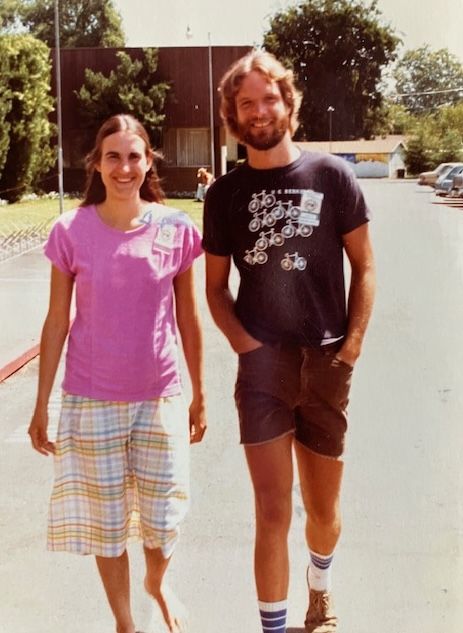
There was always a lot of emotion on the last day as Friends gathered their belongings to leave. We procrastinated until the last possible moment, clinging to each other in the parking lot. So many felt their daily lives were a desert when it came to feeling real, safe, and meaningful. As short as the gathering was, it proved a better way was possible.
Our bubble of bliss had some small fissures that grew over time. Interestingly, our differences of opinion mirrored the struggles of Early Friends. There eventually came a time when the more Christ-centered and tradition-clinging YFs felt unsatisfied with the direction the more loosey-goosey, clowning, pagan YFs were taking us. Our ranks were growing with some who were clueless about Friends’ practices. I am not particularly Christ-centric, but even I felt something important was being lost, or at least diluted. One of these newcomers, in all innocence, decided to use the seemingly empty center of our Meeting for Worship to give his girlfriend a massage. I was livid and eldered the hell out of him after the meeting was over. I assumed no one would feel entitled to use the space we save for the Holy Spirit for their personal agenda. Small missteps like this were evidence we were not all on the same page.
A crisis came when my brother, a devoted marijuana user, hugged a “straighter” YF who smelled it on him and protested loudly, feeling that my brother had crossed a line. It was clear this division was deeply damaging to our sense of unity, as half of the group was sneaking guiltily around and the other half was playing cop. The lightbulb moment came when I realized that this division proved we were not in consensus on this subject, and therefore the so-called rule was not in effect!
I brought this up to Ministry and Oversight, and a Threshing Session was called; our collective traditions as Quakers resulted in a compassionate listening environment. At the end, everyone’s feelings were heard, but no consensus was reached. No rule could survive if it was based on a top-down model in a consensus-based society. The next day, after the drama died down, a most respected Friend went around whispering into receptive ears that there was a committee meeting about to start. When we asked which committee, he replied, “Stupid Committee!” Anyone who was interested in being a part of this committee followed him to his room, and we all got high together. The stress of the previous day dissolved.
As painful as it is, the time finally comes to admit that one is no longer a Young Friend, and one must pass the baton. I have recently retired, and with the availability of Facebook, it has become easy to find and reach out to people from the past. Chances are, they are looking for old friends, too! It’s like a high school reunion; as we age, there is curiosity and a desire to come full circle. We like to remind ourselves how impactful that time and those people were to who we would become and what skills we learned along the way.
One of my Facebook connections played matchmaker between me and another formerly Young Friend from the PacYM days. We barely knew each other then; we just liked each other from a distance. It has bloomed into a love connection we never knew was possible, helped along by our shared history and mutual friends. At 70, we feel like Young Friends again.
Pan Tangible grew up in San Fernando Friends Meeting and was a professional seamstress, now retired. She is an “isolated Friend” who lives in the mountains of Southern Oregon in a custom home she built for her family. She spent the last eight years as a caregiver to her disabled spouse, and she is now widowed.