
The Threshold
- Author(s):
- Elizabeth Buckley, Caitlin Churchill
- Issue:
- Weaving (September 2026)
- Department:
- Interviews
This interview, which was edited for length and clarity, is with Elizabeth Buckley. Elizabeth is a member of the Albuquerque Monthly Meeting of Friends and is a second-generation tapestry artist and teacher of over 50 years. Her work evolved from using techniques of them Southwest USA traditions to those of French tapestry; from weaving with no pre-planned design to using a cartoon. She further honed her skills in Aubusson, France. Her tapestries often incorporate transparency and tromp l’oiel effects, through the use of techniques found in medieval and Renaissance tapestries.
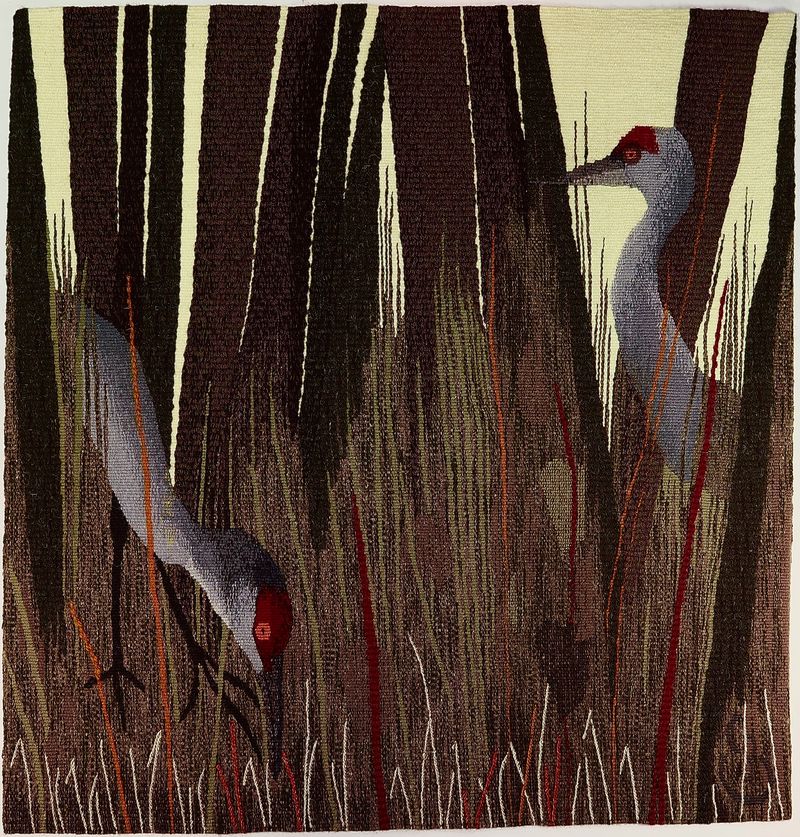
Caitlin: How has weaving connected you with a community? Can you talk about teaching weaving and also learning weaving?
Elizabeth: There are not that many tapestry weavers around in the country or in the world, so we tend to find each other to “talk tapestry,” mutually understanding the draw or appeal of this particular form of weaving. It's excruciatingly slow, very labor-intensive work. A lot of people get turned off by that if they want instant results like cloth, placemats, or scarves that weave up much quicker.
We tend to find each other through opening receptions, conferences and various ways of connecting as an international community. Now in the age of the Internet, international connections are facilitated without having to physically travel to a different country for exhibitions or conferences.
In my weaving journey, I learned to weave initially from my mom when I was a child. I learned the spectrum of weaving techniques, structures.
Are you a weaver?
Caitlin: I'm not a weaver, but I have done weaving and I understand how a loom works and that you put the shuttle in between.
Elizabeth: Tapestry is weft-faced, so the warp is totally covered up. We combine the structure of the woven fabric with the image that we are making. You have to create that structure and maintain the integrity of the cloth at the same time that you're creating images. It's a little tricky, and there are specific techniques and traditions that exist in multiple cultures around the world. Weaving is a universal, non-verbal language that transcends boundaries of culture and time.
I learned initially to approach weaving very intuitively—weaving shapes and colors and enjoying what I could do with my hands. As a child, that was the most logical thing to do. By the time I hit my 20s, I reached a point where I was spending more time staring at the loom trying to figure out where I needed to go next than actually weaving.
At that point, I realized I needed to make a roadmap for myself—to have a sense of direction with lots of latitude to let the loom and the idea inform me during the process. In my quest to find that way of working, I saw the work of Jean Pierre Larochette and Yael Lurie, who had started teaching in-person "on-the-road" workshops here in the States. Their U.S. base is in Berkeley, and they also have a place in Mexico, which is where they now live.
Jean Pierre's family originally came from Aubusson, France, which is another tapestry weaving center. During World War II, they fled the Nazi’s to relocate in Argentina, where he grew up and learned tapestry-making from his father. Jean Pierre and Yael became the foundation of the emerging tapestry weaving movement in the States during the 1970s and were core instructors at that time.
I saw their work and the potential directions I could go, and I knew they were my next teachers. They taught a workshop in Arizona back in 1989, in the days of paper newsletters mailed by snail mail. The contact person lived in Tucson—her name was Olga Neuts, who was originally from Belgium. I called her up and got her out of bed.
Caitlin: What was the time difference?
Elizabeth: Arizona doesn't change daylight saving time, and she's a night owl, not a morning person! Between the two, I could tell I had a sleepy person on the line. I apologized profusely, and she said, "No, that's no problem." She registered me and asked, "Do you have a place to stay?" I said no, and she replied, "Then come stay at my house. I have a guest room." A complete stranger welcomed me simply because of our shared desire to learn tapestry. It was that spirit of welcoming a stranger sharing a common love for this technique.
Jean Pierre and Yael traveled in an old camper. During the workshop, they parked in her driveway, and we had dinner together, speaking in French and in English. It was a lot of fun for me to practice my French and share food, stories, and family life. It made me realize there is a serious community to be found among weavers of this art form.
Jean Pierre and Yael came to Albuquerque to teach. I helped organize workshops for them here, also spreading the word, so that they could earn their living by sharing their knowledge. The French tapestry tradition is an oral one, and the teaching of tapestry was originally kept within specific families—a system from medieval and Renaissance times where each weaving studio, or atelier, maintained their competitive edge by keeping trade secrets within the family. Jean Pierre is a fourth-generation master weaver, and the people I studied with in Aubusson were also fourth-generation masters. It is a very deep, long tradition that I started to understand more, the more I worked with it.
Regarding community and how that informs my teaching: in all my workshops, I start with introductions. "Tell me where you are in your tapestry journey. Show me what you've been weaving," because I learn a lot about what students know when I see what they've done. People have an opportunity to talk about their experience, what they're trying to do, what they need to learn, and what frustrates them. I do that with every single class, whether online, in the studio, or at a conference, to nurture that sense of camaraderie—the realization of "Oh, you're not alone. I have a similar story." They swap stories and experiences, and new connections are made. Through both learning and teaching, community is definitely a central part.
Caitlin: What you said about being welcomed into someone's home reminded me of Quakerism—like having a Quaker passport. It seems like you have a weaving passport as well.
Elizabeth: Yes, it is definitely a passport.
Caitlin: When you were describing the type of weaving you do, could you explain a bit more about warp versus weft-faced? I can't quite visualize it.
Elizabeth: The warp you put on the loom is spaced far enough apart that when you weave with the weft, the warp is totally covered. All you see of the warp are its ribs, so it's weft-faced.
Caitlin: That makes sense. And the weft is the part that you weave into it?
Elizabeth: Right. There are two approaches to weaving weft-faced: one is throwing the shuttle all the way across, and the other is shape building, where you weave shape-by-shape versus straight across the row. What I do is shape-by-shape. You have to weave the underlying section first before the surrounding shapes; otherwise, you're going in with a needle trying to weave underneath what you've already woven, which becomes a nightmare.
It is usually called discontinuous weft, meaning one weft doesn't travel all the way across the row—it consists of short lengths of different weft colors.
Caitlin: And then you do another shape in another place. Do you move yourself or do you move the loom?
Elizabeth: The loom stays put; I move myself. On a small piece, you are weaving on one side of the warp, or in the middle, depending on how the shapes build up. These large floor looms are too big to move, so you move your body.
Caitlin: You mentioned previously that the loom is a threshold. What is it a threshold between, and does the meditative process enable insights regarding your artistic process or your life as a whole?
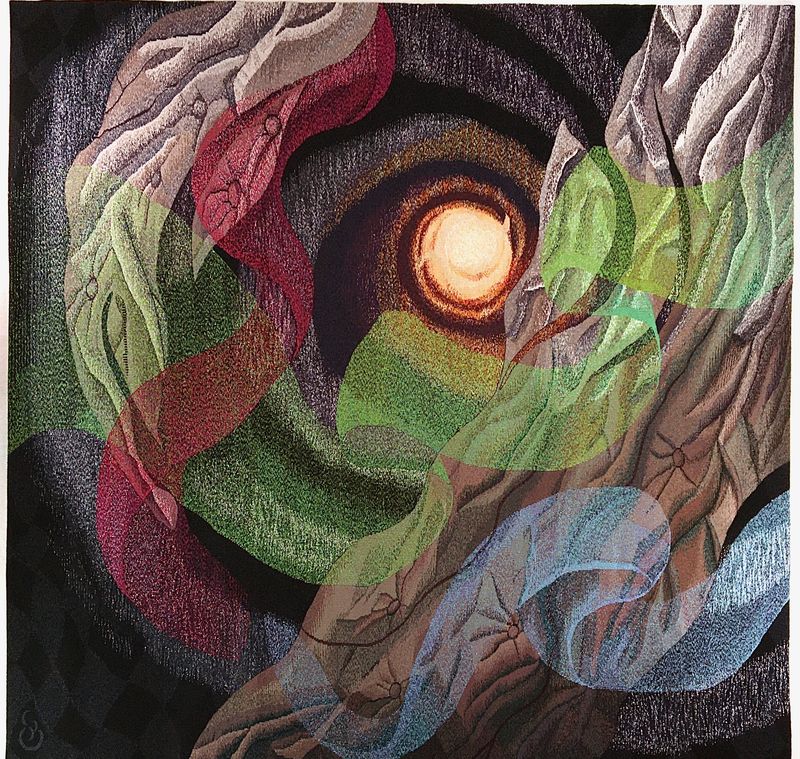
Elizabeth: Both. The threshold is like a portal between where I am sitting and where the mind goes, or what comes through the ether. It's an opening where I can be receptive to the piece on the loom informing me that something needs to change.
When I initially learned to weave, I let the piece inform me—the shapes and colors giving me ideas of what needed to go next. When I decided I needed a roadmap, I started working out overall designs before launching into the tapestry so I'd have a sense of direction. But within that, there are spaces where the tapestry still needs to inform me of what happens next, or where the ideas clarify as I weave. It's a process of listening very carefully and paying attention, which is also what meditation or sitting in meeting for worship is all about—being focused, grounded, and open to what comes. The loom tends to be the place where that happens.
Caitlin: Can you give an example of a time when something from your internal world emerged while you were weaving—a moment of awareness about your life or how you function in the world?
Elizabeth: The loom--and tapestry--is often a metaphor for life. Trusting the process—both in the piece itself and in knowing that the more I listen to that deep inner place where we connect to the divine, the answers or questions will come. While my fingers and one part of my brain are busy weaving, another part works on other things.
I remember weaving and it occurred to me that I needed to call and check in with someone. I made a mental note to call them when I reached a stopping point. Usually, that means they're in a hard place and need the comfort of someone checking in and listening. Those types of insights often come to me.
Or, if I'm wrestling with how to phrase a response to a difficult situation, the words will often come to me while I'm weaving. I keep a notepad by the loom to write down those phrases so that when I need to communicate, I have the vocabulary to put it into words in a way that is less threatening and better received.
Caitlin: I do ceramics and hand building. When I'm hand building, my brain sometimes isn't functioning in words, which I find so relaxing. Working with my hands gives me that rest.
Elizabeth: Yes, because it's the language of the nonverbal—textures, colors, shapes, and contrast. Out of the realm of the nonverbal, words can sometimes emerge.
I visited the United Kingdom August of 2025. Between teaching gigs, I spent time in the birthplace of Quakerism at the second-oldest meeting house, where they have held meeting for worship continuously since the 1600s. That length of time blows my mind.
There were seven or eight of us sitting on wooden benches in meeting for worship. It was mostly silent except for the reading of a query. As we gathered in silence, I felt the presence of all the people who had been there before sitting around us. It felt like a packed meeting for worship, with seven or eight people physically present alongside the presence of many others. That hum of quiet, centering down, and prayer surrounded us. I was in awe of it—a living silence stretching backward in time.
Caitlin: It's cool to see that tapestry behind you and your whole studio.
Elizabeth: That one, Cosmic Heart Beat, took me three years. It's about five feet by five feet. Those three years spanned COVID, when I had to take time out to learn how to teach online—navigating technology, making video, Zoom, and screen sharing. It was a huge learning curve, so I took at least six months off from the tapestry during those three years. Plus, I only weave at most four hours a day now because it's hard on the body to weave for prolonged periods.
Caitlin: That gives me a sense of the scope. How much time did the smaller one next to it take?
Elizabeth: Smaller sizes take around a year. That one was when I was juggling a day job with weaving, back when tapestry-making was part-time, before teaching could fully support me.
Caitlin: Do you teach mostly online now, or a mix?
Elizabeth: I do a mix. I developed online classes to create an opportunity to go in-depth. For example, I have a 12-week class split into two six-week sessions focused just on weaving water: reflections, ripple patterns, transparency over sand, and different techniques. I teach design theory and weaving technique simultaneously, giving people a chance to dig in, learn from mistakes, and learn from each other's projects.
Online, I do four- to six-week sessions, whereas in-person workshops are shortened four-day intensives where I beam as much information into people as possible.
Caitlin: It seems like teaching a physical craft like loom weaving online would require showing the process, not just speaking. How do you do that?
Elizabeth: I make videos and still shots showing step-by-step so students can see hands in action. I upload to Vimeo and record Zoom classes for review. What’s missing online is that I can't feel the tension of the warp to check if it's right.
In person, it's a delight to get a three-dimensional sense of the person rather than just a head-and-shoulders shot on Zoom. But online teaching has expanded my reach, leading to invitations like speaking at a conference in the UK and staying in weavers' homes.
Learning how to create illusions on a woven surface takes work. My students have taught me a lot about rephrasing concepts because everyone's brain is wired differently.
Caitlin: When you teach how to weave water, do students start from photos?
Elizabeth: Yes, we start with photos of water—emphasizing reflections with movement, ripple patterns, or creating a sense of water over rocks or sand.
Caitlin: When I draw, it's easier to draw things that don't have a specific word associated with it. Because water isn't verbally describable in a rigid way, you have to describe it in shape and color.
Elizabeth: Exactly: shape, line, value, texture, and color. It's distilling things down to essential shapes. Drawing is deeply related to tapestry weaving because we're constantly weaving shapes, alternating between positive space (the object) and negative space (the background). Drawing and tapestry-making are all about fine-tuning the hands and the eye to see and observe from the place beyond words.