
We Want To Be Invited
- Author(s):
- Isabel Arslanian
- Issue:
- Experiences of Youth (May 2026)
- Department:
- Healing the World
I was two when my parents found my childhood Quaker meeting. I remember Mimi, my First Day School teacher, reading books to us. After Meeting, we got to eat grapes and cookies. At Christmas, we all held candles during Meeting. The wax on my candle once dripped onto my hand and burned me. Because I was four, I started weeping. My parents shushing me was the first time I understood you were supposed to be quiet in Meeting. I knew I was a Quaker because my parents were and I got grapes at Meeting, but as I got older, I started wondering what else made someone a Quaker.
We moved to Olympia when I was six and joined the Olympia Friends Meeting. Both my parents joined and clerked several committees over the years. When I was younger, I would go to their committee meetings with them. I brought my books and coloring, but increasingly found myself just sitting there and listening to them. I became fascinated by the process they used to make decisions. I learned Quaker process while sitting on the floor and listening to my Quaker elders.
At the time, my favorite part of Quaker process was the way everyone’s voice was valued. I saw no reason this value shouldn’t apply to me, and yet in my short life, I had never experienced it. The obvious solution was to join a committee. Much to my dismay, the other members of the committee still didn’t consider my voice as much as each other’s. Because I’d always felt at home in my Quaker meeting and was enamored by Quaker process, I felt confused by the inconsistency. Quakerism taught me that all people have equal value, and yet I didn’t experience that. Quakers on my committees didn’t ask me questions or include me in their planning. I don’t remember being angry or hurt—only confused and determined.
As I got older, I was given more of a voice in different Quaker circles. I joined our Children’s Committee and was hired as one of the childcare providers. My family went to FGC my freshman year, and that Gathering was the biggest catalyst in my Quaker involvement. I attended a clerking workshop with my parents which scared the hell out of me. What did I think I was doing in a workshop for adults about “adulting” stuff? My parents reminded me daily that I had as much right to learn about clerking as anyone else.
I was excited by everything I was learning but had no idea what to do with it. Then, lo and behold, the High School Friends nominated me to be one of their clerks at the next Gathering. I was insanely nervous but also excited and honored. I was the youngest in a group of people I had just met, and yet they trusted me enough to give me the chance to be one of their clerks. I think that was the first time I hadn’t experienced being discounted for being younger in a Quaker circle. One amazing workshop and forty teenage Quakers gave me the confidence to interact with Quaker process in a new way. Our wonderful FGC advisors held an in-person workshop for the co-clerks that following fall. We got to know each other better, learned about clerking, and observed the Central Committee’s Business Meeting.
I served as one of the co-clerks for the FGC Gathering the following two years and have been nominated to clerk the 2026 Gathering as well. As I gained confidence, knowledge, and experience, I became more passionate about clerking. I have been a co-clerk for my Quarterly and Yearly high school groups for the last three years. As I’ve gotten more active in Quakerism and clerking, I’ve been treated as more of an equal, though still not fully. Our Yearly clerk gave me the opportunity to clerk part of the adult Business Meeting with him. I call it the “adult” Business Meeting because it’s attended by and structured for adults. Even when youth-related issues are discussed, it is still by adults. I attended every plenary session Business Meeting that week. I was the only non-adult in the room ninety percent of the time. I don’t mean these observations accusingly, only honestly. I have been incredibly supported and respected by my Quaker communities my whole life. It is because of, not despite, that fact that I find it important to highlight the inequalities I see. As Quakers in community with each other, I think we are called to remind, support, and challenge each other in the imperfect, never-ending pursuit to uphold our Quaker values. I try to do my part in that, sometimes by offering criticism to the very people who taught me those values. To me, that is the beautiful, godly gift we give each other.
I see that there is greater peace, hope, and a sense of settling when there are young people in a Quaker community. I was sitting in Meeting last Sunday and watched the faces around me melt into smiles as we listened to the cooing of a baby. I know the size and structure of youth groups vary between Meetings. Different families, ages, spaces, cultures, and traditions require different approaches. I can only offer my suggestions for how to include youth, keeping in mind that not all of them will work for every Meeting. Some people seem to be of the mind that First Day School should be as fun as possible and exclude “boring” topics, like our Quaker faith. Personally, I don’t think that does any good. Kids can have fun at the park and with their friends—they don’t need to drive to Meeting to have fun. As soon as they’re old enough to choose to go to Meeting or not, they’ll stay home if playing is the only draw.
Children are curious even when they appear bored. We need to ask Quaker kids what questions they have about Quakerism or religion. Give them opportunities to explore what they’re interested in and teach each other. I grew up completely unable to explain my “church” to my peers. I tried many different approaches, but none felt right. When asked about my religion, I found myself wondering what Quakerism even is. We should ask kids what they think Quakerism is, how they explain it to their friends, and if they have any questions about it. I don’t think it matters how old you are; these are good prompts for everyone.
If youth feel a spiritual connection to their Meeting, they will keep coming back. This connection could be an interest in learning about Quakerism, connecting with peers who have similar values, or communicating with their Higher Power. We don’t need to dictate their Higher Power or connection to Quakerism for them. What Quaker youth need is a place to talk about what they believe in and learn about our history and testimonies. In this space, they will discover their beliefs and leadings.
Adults have never stopped asking me how to attract young people to Quakerism, expecting me to tell them how to make it seem exciting and fun. That is not my suggestion. Up until a couple of years ago, I thought we weren’t allowed to tell people about Quakerism. I’d been taught that we don’t tell people what they should believe or “evangelize” them. My very literal young brain thought that meant Quakerism was a secret and that new people should only come to Meeting because they happened to be interested.
Of course, I would try to explain it to my friends and family when it came up, but I could never figure out how. If we want to include youth in our Quaker Meetings, we have to teach kids they can invite their friends. It’s important to explain the distinction between evangelizing and inviting. It’s also important to help kids come up with a way that works for them to explain Quakerism. My understanding that it wasn’t something to talk about, along with my inability to explain it, made me feel isolated. I ended up feeling, in turns, embarrassed to be a Quaker and frustrated that no one else “got it.” My frustration wasn’t about other people not sharing my beliefs; it was because I felt like it was impossible for me to share a core part of myself. I don’t think many adults realize this experience of youth and the impact it has on the overall aging of Quakerism.
My hopeful conclusion is that I invited a couple of my friends a few years ago and they’ve been coming ever since. At first, they would go with us when we went to Meeting, but eventually, they started going regularly even when my family didn’t. The other day, one of them asked me how to become a Quaker. I told her she’s a Quaker if she feels like she is, and then I explained membership. She said, “Yay! I’m a Quaker then! When I’m done with college, I want to find a Meeting to become a member of.” I didn’t convince, push, or pressure my friends to become Quakers. I simply invited them to come to Meeting once. Of course, not all my friends would continue attending if I invited them, and that’s okay. The important thing to realize is that youth will attract other youth more than anything else a Meeting does. Our job is to teach and support our youth in how to share their Quaker community.
The most important aspect is respect. No matter how old children are, they will know if they’re treated with respect. If they’re not, they will be resistant to coming back. Their opinions shouldn’t be disregarded simply because they are younger. It’s important to make sure they are aware of workshops, business meetings, and events and that they are welcome. Too often, children assume they don’t have anything to contribute. This message is partly communicated through a lack of invitation. We should let them know when youth-related topics will be discussed in Business Meeting, but also explicitly invite them to any meeting discussion they’re welcome to. That will help make sure they don’t learn that the importance of their voice is dependent on their age.
We should ask them what they are interested in and let them lead conversations. All Quakers who work with youth should pay special attention to respecting their boundaries, encouraging them to share their needs, and being honest with them. In my Meeting, we had an ongoing conflict for several years, and I often felt disrespected because adults weren’t honest with me about things going on. No matter how fun or engaging First Day School and Quaker events are, it won’t matter if youth don’t feel respected.
Youth add unique light to our communities. As Quakers, it’s important to us to be inclusive. To prevent Quakerism from dying out, we need to find better ways to share it with younger generations. This matters to me because my faith is one of the most important things in my life. I truly don’t believe other people need to discover my faith or believe in my God to be complete. I actually have no idea what other people need. What I do know is that I was offered a safe space to explore and create my relationship with my Higher Power. I believe this is one of the biggest gifts I’ve gotten in life. I care deeply about offering that gift to other young people.
When I was younger, I was an adamant atheist. Nobody cared. I think that made me wonder what else I could get away with believing. The answer, I discovered, was anything that still respected the light in every other person. I have no idea how old I was when I started feeling like I had a Higher Power. I think I grabbed onto my one rule—respect that of God in everyone—and that became the foundation of my faith. Over and over, I saw the evidence of “that of God” in other people. It made me wonder what it was. I don’t know what it is. How could I? I’m a human, not God. What matters to me is that I recognize and respect it in everyone.
When I pray and listen humbly, I receive guidance and support. I don’t know where it comes from, so I just call it God. When people ask me why I believe in God with no solid proof, I say it’s because it makes me a better person. I am more centered, honest, compassionate, caring, and trusting when I talk and listen to my Higher Power. I receive clarity about what I need to do, which has helped me through every difficult experience I’ve had. God doesn’t fix anything for me. God doesn’t give me a car or the opportunity I want. God gives me what I need.
Growing up as a Quaker provided me with the space to talk, think, and wonder about my Higher Power. It gave me a community to love me and hold me in the light as I developed my relationship with my Higher Power. And in turn, my Higher Power has taught me to always advocate for what is right, to respect and love everyone, and to always advocate for what I need. I want to share my experiences, observations, and questions so that we as a community can welcome youth and give them the gift I received. There’s no telling where that gift will lead them, what Higher Power they’ll find, or the relationship they’ll have. Our only role is to continue down our own journeys and support other people in theirs. D
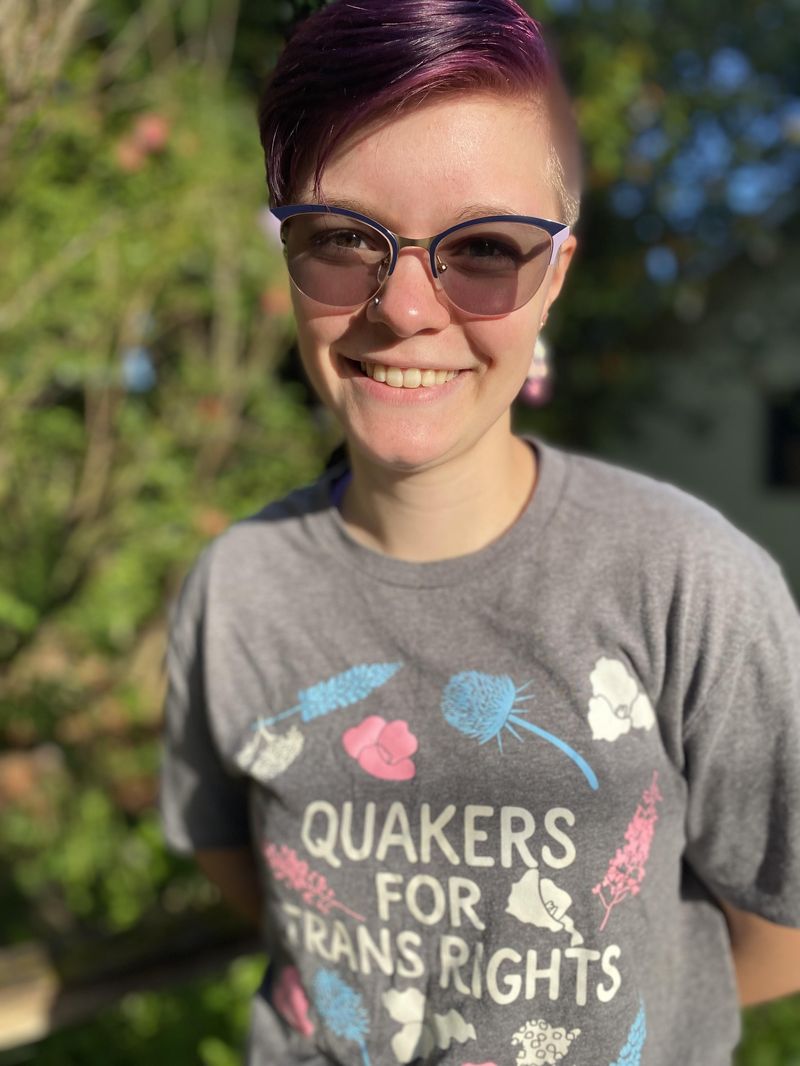
Isabel Arslanian is a member of Olympia Monthly Meeting. She loves teaching violin lessons and gardening. She will graduate from high school and South Puget Sound Community College with her Associates of Biology in the spring and attend Evergreen State College in the fall. Isabel lives in Olympia, Washington, with her parents, Michael and Karma, her sister Escher, and her cat and dog.